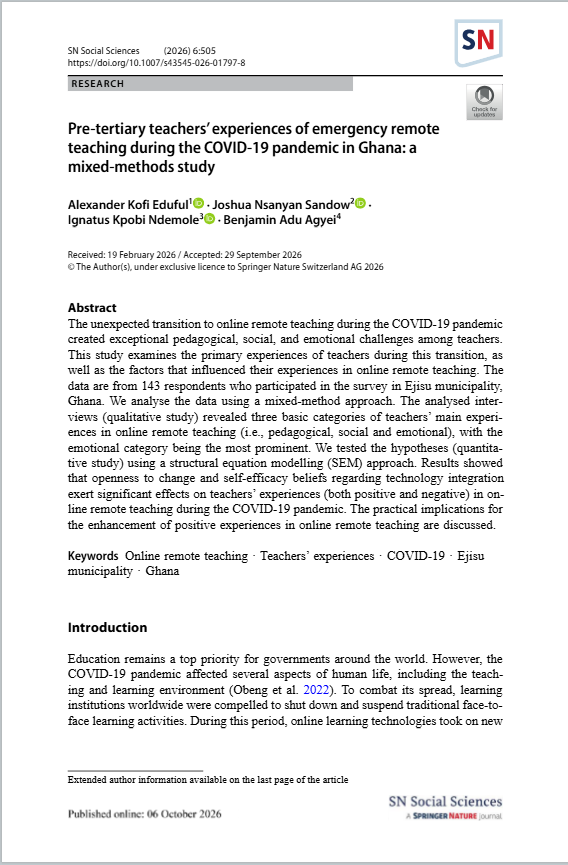
The paper, titled “Pre-tertiary teachers’ experiences of emergency remote teaching during the COVID-19 pandemic in Ghana: a mixed-methods study,” has been published in SN Social Sciences, a Springer Nature journal. This publication builds on KECCDR's growing commitment to generating evidence on issues that directly affect communities and contribute to meaningful development practice. When the COVID-19 pandemic forced schools to close their physical classrooms, teachers were suddenly required to adapt to unfamiliar forms of remote teaching. For many educators, the transition was not simply a technological challenge. It affected how they taught, how they interacted with their students and colleagues, and how they experienced their own roles as educators
The new study explores these experiences among 143 pre-tertiary teachers in Ejisu Municipality, using a mixed-methods approach to examine the pedagogical, social and emotional dimensions of emergency remote teaching. The research identified three major dimensions of teachers' experiences: pedagogical, social and emotional. Notably, emotional experiences emerged as the most prominent category. The study also found that teachers' openness to change and their self-efficacy in integrating technology significantly influenced how they experienced the transition to remote teaching. One of the important lessons emerging from the research is that digital education cannot be understood simply as a question of access to devices, internet connectivity or digital platforms
Behind every technology-enabled classroom is a teacher. And behind every teacher is a person who must adapt, learn, cope with uncertainty and continue supporting learners under challenging circumstances. The findings therefore highlight the importance of considering the psychological, social and emotional experiences of teachers when developing technology supported education systems. This is particularly relevant as education systems continue to explore digital and blended approaches to teaching and learning. The study's focus on teachers in Ejisu Municipality reflects an important aspect of KECCDR's research philosophy: generating knowledge that is grounded in real community experiences.
KECCDR was established as the research unit of FASUL to undertake and support interdisciplinary, community-based research addressing the needs and development challenges of rural and underserved communities. Its areas of interest span education, health, water and sanitation, child and adolescent wellbeing, and broader community development. This second publication demonstrates how research emerging from local communities can contribute to broader conversations about education, technology and development. The publication marks another step forward for KECCDR since the establishment of the research unit.
Its first published paper examined predictors of unintended pregnancy among adolescent schoolgirls during COVID-19-induced school closures in rural and underserved communities in Ghana, highlighting another important issue affecting children and families in underserved settings. The second publication now expands KECCDR's research contribution into the area of education, technology and teacher experiences, demonstrating the breadth of issues that community-based research can address. Together, these publications represent more than academic achievements. They reflect FASUL's growing commitment to ensuring that its work is informed by evidence, research and a deeper understanding of the communities it serves. This progress has been made possible through the dedication of the KECCDR research team and the wider network of academic and development collaborators connected to FASUL.
FASUL's journey has also been strengthened by its longstanding relationships with international partners, including the Kiphart family and partners in Chicago and the University of Chicago, whose collaboration has played an important role in advancing FASUL's work in Ghana. FASUL's history records the longstanding connection between the organisation, the Kipharts and the University of Chicago, while the research unit itself continues to work with academic institutions, development partners and community stakeholders. The new publication further demonstrates the value of bringing together local research capacity, academic expertise and international collaboration to generate knowledge that can contribute to better development outcomes.
For KECCDR, publication is not the final destination. The real value of research lies in what happens after the findings are shared when evidence informs conversations, strengthens programmes, influences policy and helps communities and institutions make better decisions. As KECCDR continues to grow, FASUL remains committed to building a research culture that does more than produce papers. This second publication is therefore not simply another paper. It is another step in FASUL's journey from community experience to evidence, and from evidence to action.
Congratulations to the Kiphart-Eduful Center for Community Development Research (KECCDR) and the research team on this important achievement.
FASUL – Family Support Lifeline Supporting Families to Develop the Child